Articles

These articles will look into what we know about life in the past, how we can share it and what it meant to individuals and to us today.

This website is a space to share my research into how we lived in the past and how much the culture around us affects us. I want everyone to be able to find history that appeals to them and represents their experiences. This is why I work in heritage, to bring history to life and to reach more people. The articles fit under my main four themes, but you can also sort them by more specific tags.

  • Interpretation, exhibitions & curation
  • My experiences and learnings from the  heritage sector
  • Making heritage more accessible and representative.
  • Sharing my historical research, both from my academic work and new research
  • Findings from archive research focused on identity – including social, cultural and gender history.

This covers everything else I’m interested in that’s connected to history.

  • Intangible heritage
  • Learning through making
  • Historical dress

My main fascination with history comes from why we behaved and understood things differently and how society and identity interconnect.

  • Social Constructs
  • Masculinity and Femininity
  • Neurodiversity
  • Campaigns for greater equality and representation
  • The role of activism in the sector.
Infographic Poster. Reasons to Recreate - To work out how something fits together - To see what it feels like to wear it (embodiment) - to analyse historical instructions - to bring something to life such as film or TV setting - to spot the changes made between styles
The very first Making Historical Dress Conference explored how different ideas about making and researching historical costume and craft intersect.
These look very similar which is why this is know as One Sex Theory - they are two versions of the same organs.
There are more and more ways a person can describe their gender. Its common for those scared by these developments to reference back to a past where things were simpler. In reality, those in the past also viewed gender as a spectrum, just like we are moving back to today.
Ideal Body Shape section of Stories Told in Stitches Exhibition. A glass case on the left shows a hat box, bowler hat and brush with interpretation notes. The middle and right feature manequins wearing a 1840s mouring dress, a 1900s s-bend corset, and a 1920s flapper dress.
My exhibition found stories about clothing – seeing how and what they showed about gender.
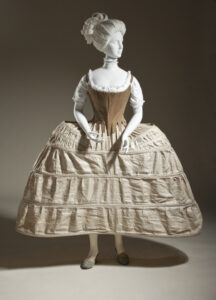
Mannequin wearing a 1700 stays (early version of Corset) and Paniers which were a hoop like structure that went under the gowns so it extended the width of the torso out to either side yet was an oval when seen from above.
Fashion trends return to the same idea and values almost every 100 years. They may have different presentations but there's definitely a repetitive fashion loop.
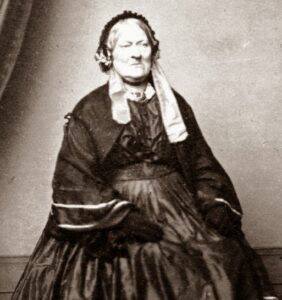
Victorian photograph of Lily Maxwell sat down. The first women voter in 1867,
Most people know 1918 as the first time some women voted in the UK, but women successfully voted in the 1869 election. The suffragists of Manchester led a huge campaign after spotting that the wording of the 1868 Reform Bill was wrong. The wording accidentally enfranchised women who met its other criteria, leading to thousands of women voting.