Last month, I attended the very first Making Historical Dress Conference. This explored how different ideas about making and researching historical costumes and crafts intersect. For this article, I’m using the term ‘dress history’ to refer to all these parts as a collective. It was amazing to see people I’ve followed on twitter as ‘real people’ and see their ideas come to life.
One of the ideas taken up immediately by the other speakers was Hilary Davidson’s suggestion of stating researchers should share their experiences and opinionsto help make others aware of their bias. This helps identify more subjective arguments or why a different person might come up with different conclusions.
Recognising ideas from other fields and cultures enables collaboration, without claiming ideas apply directly. Work becomes intersectional and considers how the experiences of the researcher will affect the conclusions they make. This could be their own experiences or their perspective such as a Marxist approach.
I’ve always been passionate about historical dress and wanted to learn all about it, but I’ve never managed to put the skills into practice. Hearing some speakers acknowledge that making items is something they can only do theoretically was also reassuring.h
I think one of her points is often misunderstood or overlooked. All history is using evidence available to prove a suggestion but it can always be replaced. She highlighted how this is true of all form of science – even famous scientists had their theories replaced and updated later on.
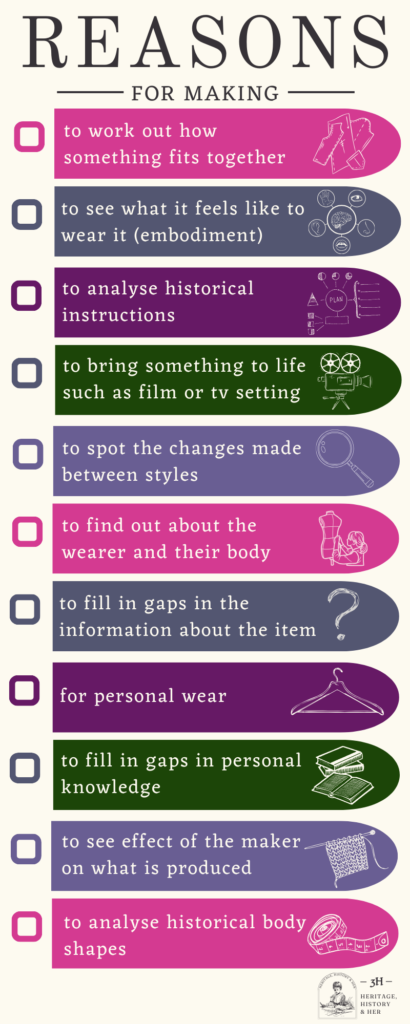
I think one of her points is often misunderstood or overlooked. All history uses the evidence available to prove a suggestion but it can always be replaced. She highlighted how this is true of all forms of science – even famous scientists had their theories replaced and updated later on.

Suggestion: Follow @FourRedShoes
Hilary Davidson is my number one recommendation for costumes a dress historian to follow on Twitter. See her deep-dive analysis of film costume and bonkers theories that still make perfect sense. Did you know Regency hair is a mullet? Or that the Modern, Early Modern and Medieval era can be told apart by the position of boobs?
One way of sharing knowledge is by changing the way reenactors and members of the public are seen. We can include them directly into research and academia by casting them as ‘Citizen Researchers’. This term originated in citizen science. For example, the public help collect data for RSPB’s Big Garden Bird Watch by recording the different birds in their gardens.
I think this approach to dress history might have to be later down the line. It implies the public can help by contributing to an already existing data set. This would require the collation of what we already know into resources that can be shared first. Preventing reenactors, crafters and historians from spending time rediscovering what others already know would free up time for this.
One of the ideas taken up immediately by the other speakers was Hilary Davidson’s suggestion of stating researchers should share their experiences and opinionsto help make others aware of their bias. This helps identify more subjective arguments or why a different person might come up with different conclusions.
Recognising ideas from other fields and cultures enables collaboration, without claiming ideas apply directly. Work becomes intersectional and considers how the experiences of the researcher will affect the conclusions they make. This could be their own experiences or their perspective such as a Marxist approach.
I’ve always been passionate about historical dress and wanted to learn all about it, but I’ve never managed to put the skills into practice. Hearing some speakers acknowledge that making items is something they can only do theoretically was also reassuring.h
Jane also explored the different methods to making dress based on Wayland Barbour’s earlier theory:
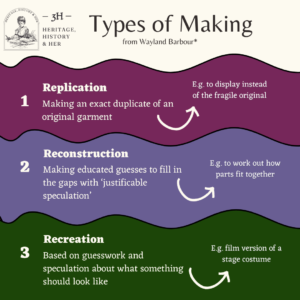
Jane also expressed the importance of the term ‘construct’ in ‘reconstruction’. She talked about how important it is to show the transparency of the fact it is an educated guess yet involves much subjective judgment. This completes the net of how all these ideas fit together – back to the idea Hilary brought up of how history is just increasingly educated guesses but that is more clear in fields like dress history.
There were many other really valuable talks as part of this conference. I found many new people to follow their discoveries so watch out for my ideas inspired by theirs in the future. I’m also working on articles on engagement and ways of illustrating techniques so watch out for them too!